M203 20260321 Circle and Triangle Problems
Many Gothic cathedrals have windows with portions containing a ring of congruent circles that are circumscribed by a larger circle, In the figure shown, the number of smaller circles is four. What is the ratio of the sum of the areas of the four smaller circles to the area of the larger circle?
2009 AMC 10A Problems/Problem 21
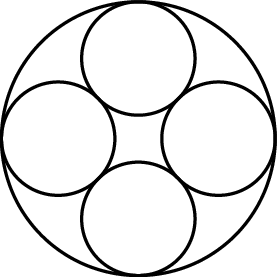
$\mathrm{(A)}\ 3-2\sqrt2 \qquad \mathrm{(B)}\ 2-\sqrt2 \qquad \mathrm{(C)}\ 4(3-2\sqrt2) \qquad \mathrm{(D)}\ \frac12(3-\sqrt2) \qquad \mathrm{(E)}\ 2\sqrt2-2$
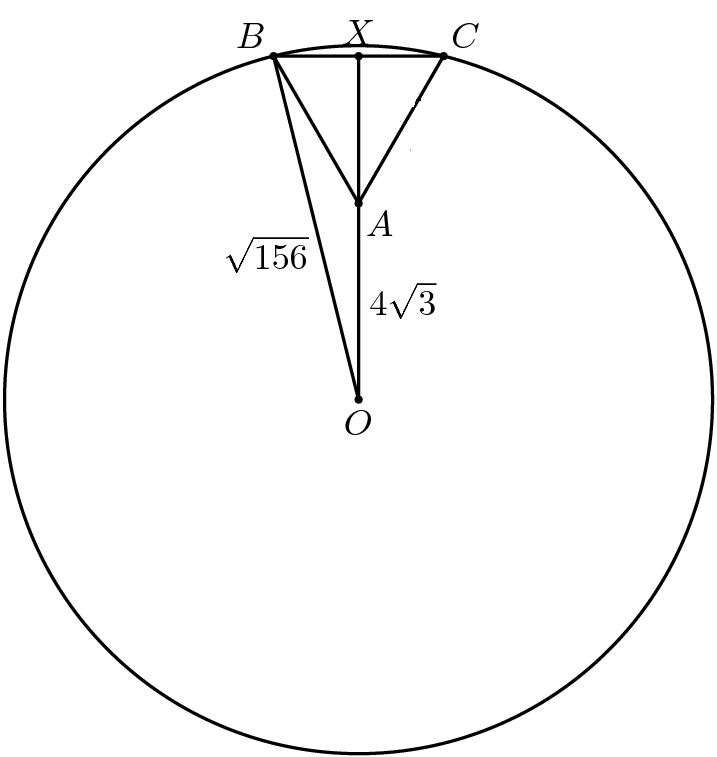
A circle with center $O$ has area $156\pi$. Triangle $ABC$ is equilateral, $\overline{BC}$ is a chord on the circle, $OA = 4\sqrt{3}$, and point $O$ is outside $\triangle ABC$. What is the side length of $\triangle ABC$?
2010 AMC 10B Problems/Problem 19
$\textbf{(A)}\ 2\sqrt{3} \qquad \textbf{(B)}\ 6 \qquad \textbf{(C)}\ 4\sqrt{3} \qquad \textbf{(D)}\ 12 \qquad \textbf{(E)}\ 18$
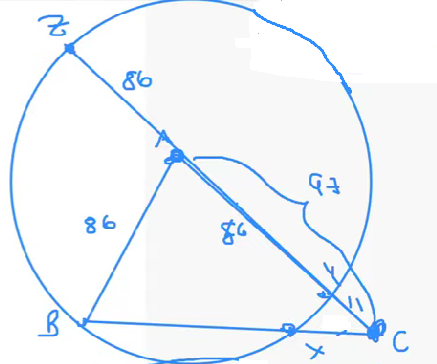
In $\triangle ABC$, $AB = 86$, and $AC=97$. A circle with center $A$ and radius $AB$ intersects $\overline{BC}$ at points $B$ and $X$. Moreover $\overline{BX}$ and $\overline{CX}$ have integer lengths. What is $BC$?
2013 AMC 10A Problems/Problem 23
$\textbf{(A)}\ 11\qquad\textbf{(B)}\ 28\qquad\textbf{(C)}\ 33\qquad\textbf{(D)}\ 61\qquad\textbf{(E)}\ 72$
#Power_Of_A_Point
Two concentric circles have radii $1$ and $2$. Two points on the outer circle are chosen independently and uniformly at random. What is the probability that the chord joining the two points intersects the inner circle?
2014 AMC 10B Problems/Problem 19
$\textbf{(A)}\ \frac{1}{6}\qquad \textbf{(B)}\ \frac{1}{4}\qquad \textbf{(C)}\ \frac{2-\sqrt{2}}{2}\qquad \textbf{(D)}\ \frac{1}{3}\qquad \textbf{(E)}\ \frac{1}{2}\qquad$
From AOPS:This problem is exactly the Bertrand paradox! I feel sorry for students who took 2014 AMC 10B :-( The answers (E) 1/2, (D) 1/3, and (B) 1/4 are all correct, depending on what kind of uniform you choose. (1) If you choose angle uniform, the probability is 1/3. (2) If you choose the center of the chord is uniformly distributed in the big circle, the probability is 1/4. (3) If you choose the center of the chord is uniformly distributed along a radius (i.e. 0 to 2 from the center of the big circle), the probability is 1/2.
If circular arcs $AC$ and $BC$ have centers at $B$ and $A$, respectively, then there exists a circle tangent to both $\overparen{AC}$ and $\overparen{BC}$, and to $\overparen{AB}$. If the length of $\overparen{BC}$ is $12$, then the circumference of the circle is
2000 AMC 12 Problems/Problem 24
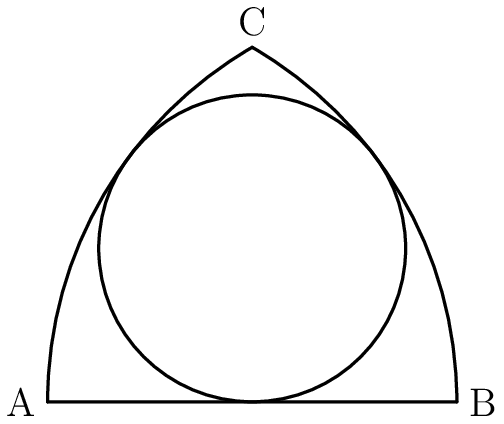
$\textbf {(A)}\ 24 \qquad \textbf {(B)}\ 25 \qquad \textbf {(C)}\ 26 \qquad \textbf {(D)}\ 27 \qquad \textbf {(E)}\ 28$
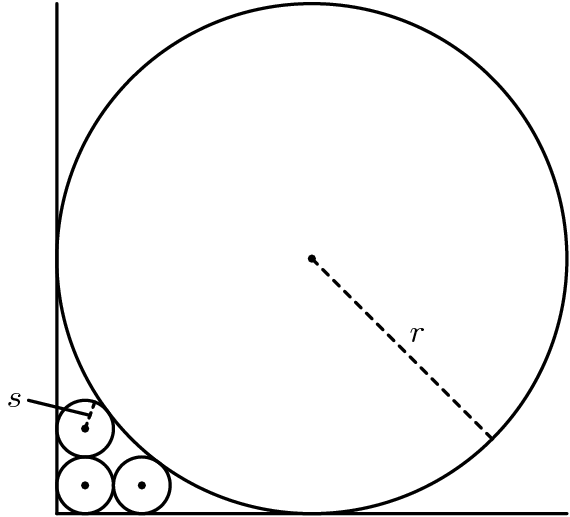
Three circles of radius $s$ are drawn in the first quadrant of the $xy$-plane. The first circle is tangent to both axes, the second is tangent to the first circle and the $x$-axis, and the third is tangent to the first circle and the $y$-axis. A circle of radius $r > s$ is tangent to both axes and to the second and third circles. What is $r/s$?
2005 AMC 12A Problems/Problem 16
$(\mathrm {A}) \ 5 \qquad (\mathrm {B}) \ 6 \qquad (\mathrm {C})\ 8 \qquad (\mathrm {D}) \ 9 \qquad (\mathrm {E})\ 10$
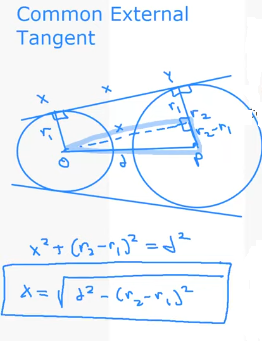
#Common_External_Tangent
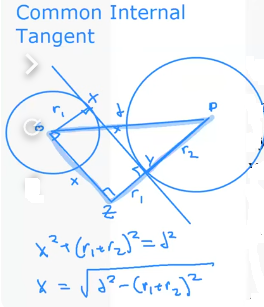
#Common_Internal_Tangent
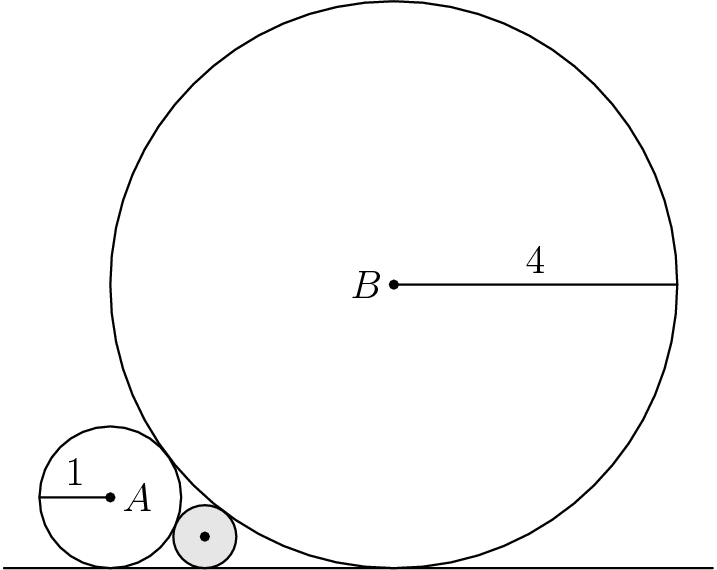
A circle centered at $A$ with a radius of 1 and a circle centered at $B$ with a radius of 4 are externally tangent. A third circle is tangent to the first two and to one of their common external tangents as shown. What is the radius of the third circle?
2001 AMC 12 Problems/Problem 18
$\text{(A) }\frac {1}{3} \qquad \text{(B) }\frac {2}{5} \qquad \text{(C) }\frac {5}{12} \qquad \text{(D) }\frac {4}{9} \qquad \text{(E) }\frac {1}{2}$
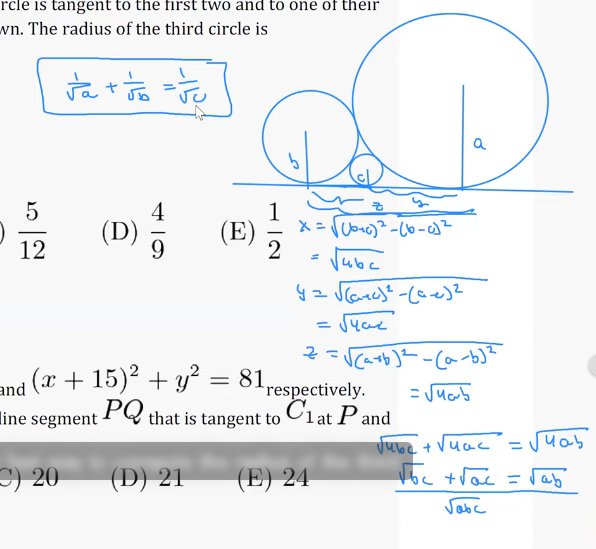
Let $C_1$ and $C_2$ be circles defined by $(x-10)^2 + y^2 = 36$ and $(x+15)^2 + y^2 = 81$ respectively. What is the length of the shortest line segment $PQ$ that is tangent to $C_1$ at $P$ and to $C_2$ at $Q$?
2002 AMC 12A Problems/Problem 18
$\text{(A) }15 \qquad \text{(B) }18 \qquad \text{(C) }20 \qquad \text{(D) }21 \qquad \text{(E) }24$
Circle $C_1$ has its center $O$ lying on circle $C_2$. The two circles meet at $X$ and $Y$. Point $Z$ in the exterior of $C_1$ lies on circle $C_2$ and $XZ=13$, $OZ=11$, and $YZ=7$. What is the radius of circle $C_1$?
2012 AMC 12A Problems/Problem 16
$\textbf{(A)}\ 5\qquad\textbf{(B)}\ \sqrt{26}\qquad\textbf{(C)}\ 3\sqrt{3}\qquad\textbf{(D)}\ 2\sqrt{7}\qquad\textbf{(E)}\ \sqrt{30}$
#Inscribed_Angle_Theorom
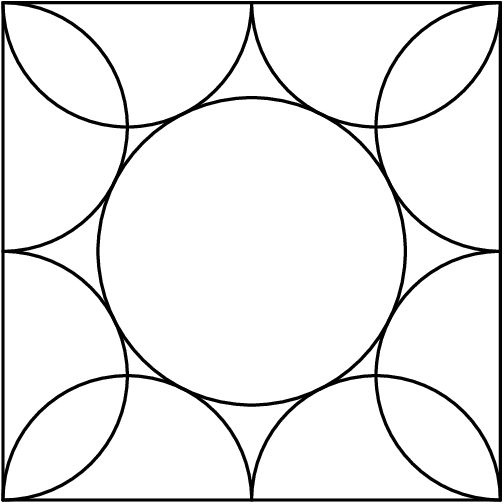
Eight semicircles line the inside of a square with side length 2 as shown. What is the radius of the circle tangent to all of these semicircles?
2014 AMC 10B Problems/Problem 22
$\text{(A) } \dfrac{1+\sqrt2}4 \quad \text{(B) } \dfrac{\sqrt5-1}2 \quad \text{(C) } \dfrac{\sqrt3+1}4 \quad \text{(D) } \dfrac{2\sqrt3}5 \quad \text{(E) } \dfrac{\sqrt5}3$
Triangle $ABC$ has $AB=27$, $AC=26$, and $BC=25$. Let $I$ be the intersection of the internal angle bisectors of $\triangle ABC$. What is $BI$?
2012 AMC 12A Problems/Problem 18
$\textbf{(A)}\ 15\qquad\textbf{(B)}\ 5+\sqrt{26}+3\sqrt{3}\qquad\textbf{(C)}\ 3\sqrt{26}\qquad\textbf{(D)}\ \frac{2}{3}\sqrt{546}\qquad\textbf{(E)}\ 9\sqrt{3}$
#Inradius_Formula
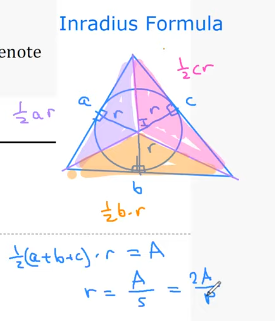
$s$ is the semi-perimeter: $s = \frac{a+b+c}{2}$
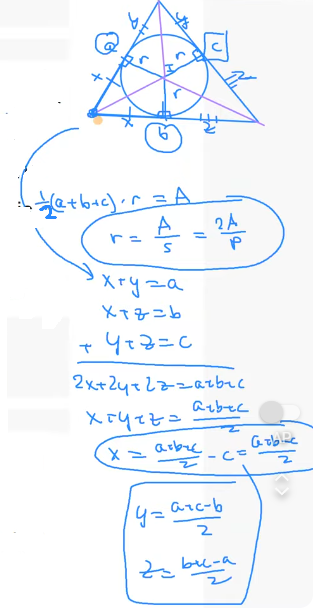
Let $T_1$ be a triangle with side lengths $2011, 2012,$ and $2013$. For $n \ge 1$, if $T_n = \triangle ABC$ and $D, E,$ and $F$ are the points of tangency of the incircle of $\triangle ABC$ to the sides $AB, BC$, and $AC,$ respectively, then $T_{n+1}$ is a triangle with side lengths $AD, BE,$ and $CF,$ if it exists. What is the perimeter of the last triangle in the sequence $( T_n )$?
2011 AMC 10B Problems/Problem 25
$\textbf{(A)}\ \frac{1509}{8} \qquad\textbf{(B)}\ \frac{1509}{32} \qquad\textbf{(C)}\ \frac{1509}{64} \qquad\textbf{(D)}\ \frac{1509}{128} \qquad\textbf{(E)}\ \frac{1509}{256}$
📝 Homework & Extensions
2010 AMC 10B Problems/Problem 20
Two circles lie outside regular hexagon $ABCDEF$. The first is tangent to $\overline{AB}$, and the second is tangent to $\overline{DE}$. Both are tangent to lines $BC$ and $FA$. What is the ratio of the area of the second circle to that of the first circle?
$\textbf{(A)}\ 18 \qquad \textbf{(B)}\ 27 \qquad \textbf{(C)}\ 36 \qquad \textbf{(D)}\ 81 \qquad \textbf{(E)}\ 108$
Solution 1
A good diagram is very helpful.
[[media/b7ea6fa40e89f6a37c774c8cb955d14b_MD5.png|Open: Pasted image 20260404105932.png]]
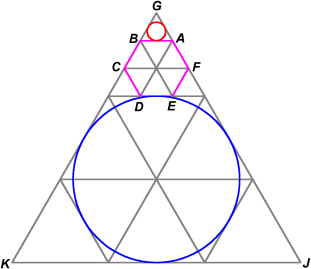
The first circle is in red, the second in blue. With this diagram, we can see that the first circle is inscribed in equilateral triangle $GBA$ while the second circle is inscribed in $GKJ$. From this, it's evident that the ratio of the blue area to the red area is equal to the ratio of the areas $\triangle GKJ$ to $\triangle GBA$
Since the ratio of areas is equal to the square of the ratio of lengths, we know our final answer is $\left(\frac{GK}{GB}\right)^2$. From the diagram, we can see that this is $9^2=\boxed{\textbf{(D)}\ 81}$
Solution 2
As above, we note that the first circle is inscribed in an equilateral triangle of side length $1$ (if we assume, WLOG, that the regular hexagon has side length $1$). The inradius of an equilateral triangle with side length $1$ is equal to $\frac{\sqrt{3}}{6}$. Therefore, the area of the first circle is $(\frac{\sqrt{3}}{6})^2 \cdot \pi =\frac{\pi}{12}$.
Call the center of the second circle $O$. Now we drop a perpendicular from $O$ to circle $O$'s point of tangency with $GK$ and draw another line connecting $O$ to $G$. Note that because triangle $BGA$ is equilateral, $\angle BGA=60^{\circ}$. $OG$ bisects $\angle BGA$, so we have a $30-60-90$ triangle.
Call the radius of circle $O$ $r$. $OG=2r= \text{height of equilateral triangle} + \text{height of regular hexagon} + r$
The height of an equilateral triangle of side length $1$ is $\frac{\sqrt{3}}{2}$. The height of a regular hexagon of side length $1$ is $\sqrt{3}$. Therefore, $OG=\frac{\sqrt{3}}{2} + \sqrt{3} + r$.
We can now set up the following equation:
$\frac{\sqrt{3}}{2} + \sqrt{3} + r=2r$
$\frac{\sqrt{3}}{2} + \sqrt{3}=r$
$\frac{3\sqrt{3}}{2}=r$
The area of Circle $O$ equals $\pi r^2=\frac{27}{4} \pi$
Therefore, the ratio of the areas is $\frac{\frac{27}{4}}{\frac{1}{12}}=\boxed{\textbf{(D)}\ 81}$
In triangle $ABC$, $AB=13$, $BC=14$, and $CA=15$. Distinct points $D$, $E$, and $F$ lie on segments $\overline{BC}$, $\overline{CA}$, and $\overline{DE}$, respectively, such that $\overline{AD}\perp\overline{BC}$, $\overline{DE}\perp\overline{AC}$, and $\overline{AF}\perp\overline{BF}$. The length of segment $\overline{DF}$ can be written as $\frac{m}{n}$, where $m$ and $n$ are relatively prime positive integers. What is $m+n$?
$\textbf{(A)}\ 18\qquad\textbf{(B)}\ 21\qquad\textbf{(C)}\ 24\qquad\textbf{(D)}\ 27\qquad\textbf{(E)}\ 30$
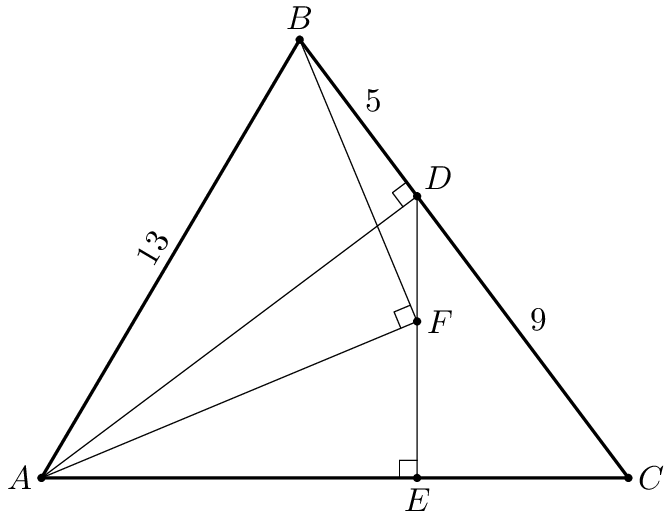
Since $\angle{AFB}=\angle{ADB}=90^{\circ}$, quadrilateral $ABDF$ is cyclic. It follows that $\angle{ADE}=\angle{ABF}$, so $\triangle ABF \sim \triangle ADE$ are similar. In addition, $\triangle ADE \sim \triangle ACD$. We can easily find $AD=12$, $BD = 5$, and $DC=9$ using Pythagorean triples.
So, the ratio of the longer leg to the hypotenuse of all three similar triangles is $\tfrac{12}{15} = \tfrac{4}{5}$, and the ratio of the shorter leg to the hypotenuse is $\tfrac{9}{15} = \tfrac{3}{5}$. It follows that $AF=(\tfrac{4}{5}\cdot 13), BF=(\tfrac{3}{5}\cdot 13)$.
Let $x=DF$. By Ptolemy's Theorem, we have\[13x+\left(5\cdot 13\cdot \frac{4}{5}\right)= 12\cdot 13\cdot \frac{3}{5} \qquad \Leftrightarrow \qquad 13x+52=93.6.\]Dividing by $13$ we get $x+4=7.2\implies x=\frac{16}{5}$ so our answer is $\boxed{\textbf{(B) }21}$.
2016 AMC 10A Problems/Problem 19
In rectangle $ABCD,$ $AB=6$ and $BC=3$. Point $E$ between $B$ and $C$, and point $F$ between $E$ and $C$ are such that $BE=EF=FC$. Segments $\overline{AE}$ and $\overline{AF}$ intersect $\overline{BD}$ at $P$ and $Q$, respectively. The ratio $BP:PQ:QD$ can be written as $r:s:t$ where the greatest common factor of $r,s,$ and $t$ is $1.$ What is $r+s+t$?
$\textbf{(A) } 7 \qquad \textbf{(B) } 9 \qquad \textbf{(C) } 12 \qquad \textbf{(D) } 15 \qquad \textbf{(E) } 20$
Solution 1 (Similar Triangles)
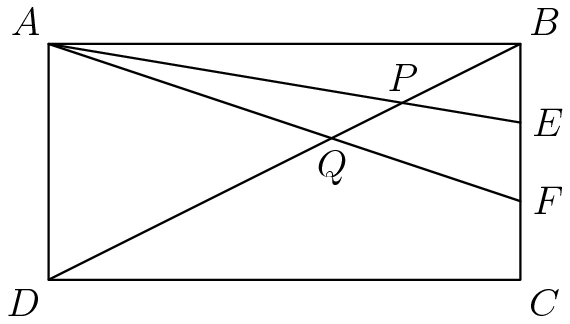
Use similar triangles. Our goal is to put the ratio in terms of ${BD}$. Since $\triangle APD \sim \triangle EPB,$ $\frac{DP}{PB}=\frac{AD}{BE}=3.$ Therefore, $PB=\frac{BD}{4}$. Similarly, $\frac{DQ}{QB}=\frac{3}{2}$. This means that ${DQ}=\frac{3\cdot BD}{5}$. Therefore, $r:s:t=\frac{1}{4}:\frac{2}{5}-\frac{1}{4}:\frac{3}{5}=5:3:12,$ so $r+s+t=\boxed{\textbf{(E) }20.}$
Solution 2 (Mass points and Similar Triangles - Easy)
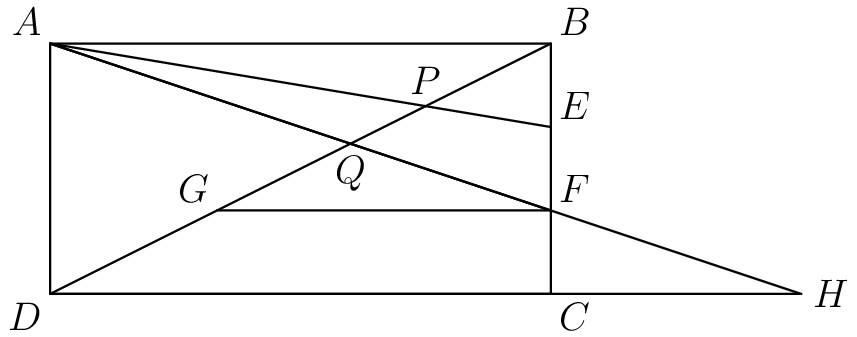
This problem breaks down into finding $QP:PB$ and $DQ:QB$. We can find the first using mass points, and the second using similar triangles.
Draw point $G$ on $DB$ such that $FG\parallel CD$. Then, by similar triangles $FG=BF\cdot 2=4$. Again, by similar triangles $AQB$ and $FQG$, $AQ:FQ=AB:FG=6:4=3:2$. Now we begin Mass Points.
We will consider the triangle $ABF$ with center $P$, so that $E$ balances $B$ and $F$, and $Q$ balances $A$ and $F$. Assign a mass of $1$ to $B$. Then, $BE:FE=1:1$ so $F=B=1$. By mass points addition, $E=B+F=2$ since $E$ balances $B$ and $F$. Also, $AQ:QF=3:2$ so $A=\frac{2}{3}F=\frac{2}{3}$ so $Q=\frac{5}{3}$. Then, $QP:PB=1:\frac{5}{3}=3:5$.
To calculate $DQ:BQ$, extend $AF$ past $F$ to point $H$ such that $H$ lies on $BC$. Then $AFB$ is similar to $HAD$ so $DH=3\cdot AD=9$. Also, $AQB$ is similar to $HQD$ so $DQ:BQ=9:6=3:2$
Now, we wish to get $DQ:QP:PB$. Observe that $BQ=QP+PB$. So, $DQ:BQ=DQ:QP+PB=3:2$ so (since $QP:PB=3:5$ has sum $3+5=8$), $DQ:QP+PB=3:2=12:8$. now, we may combine the two and get $DQ:QP:PB=12:3:5$ so $r+s+t=12+3+5=\boxed{\textbf{(E) }20}$.
~Firebolt360(minor edits by vadava_lx)
Solution 3(Coordinate Bash)
We can set coordinates for the points. $D=(0,0), C=(6,0), B=(6,3),$ and $A=(0,3)$. The line $BD$'s equation is $y = \frac{1}{2}x$, line $AE$'s equation is $y = -\frac{1}{6}x + 3$, and line $AF$'s equation is $y = -\frac{1}{3}x + 3$. Adding the equations of lines $BD$ and $AE$, we find that the coordinates of $P$ are $\left(\frac{9}{2},\frac{9}{4}\right)$. Furthermore we find that the coordinates of $Q$ are $\left(\frac{18}{5}, \frac{9}{5}\right)$. Using the Pythagorean Theorem, we get that the length of $QD$ is $\sqrt{\left(\frac{18}{5}\right)^2+\left(\frac{9}{5}\right)^2} = \sqrt{\frac{405}{25}} = \frac{\sqrt{405}}{5} = \frac{9\sqrt{5}}{5}$, and the length of $DP$ is $\sqrt{\left(\frac{9}{2}\right)^2+\left(\frac{9}{4}\right)^2} = \sqrt{\frac{81}{4} + \frac{81}{16}} = \sqrt{\frac{405}{16}} = \frac{\sqrt{405}}{4} = \frac{9\sqrt{5}}{4}.$ $PQ = DP - DQ = \frac{9\sqrt{5}}{4} - \frac{9\sqrt{5}}{5} = \frac{9\sqrt{5}}{20}.$ The length of $DB = \sqrt{6^2 + 3^2} = \sqrt{45} = 3\sqrt{5}$. Then $BP= 3\sqrt{5} - \frac{9\sqrt{5}}{4} = \frac{3\sqrt{5}}{4}.$ The ratio $BP : PQ : QD = \frac{3\sqrt{5}}{4} : \frac{9\sqrt{5}}{20} : \frac{9\sqrt{5}}{5} = 15\sqrt{5} : 9\sqrt{5} : 36\sqrt{5} = 15 : 9 : 36 = 5 : 3 : 12.$ Then $r, s,$ and $t$ is $5, 3,$ and $12$, respectively. The problem tells us to find $r + s + t$, so $5 + 3 + 12 = \boxed{\textbf{(E) }20}$ ~ minor $\LaTeX$ edits by dolphin7
Solution 4
Extend $AF$ to meet $CD$ at point $T$. Since $FC=1$ and $BF=2$, $TC=3$ by similar triangles $\triangle TFC$ and $\triangle AFB$. It follows that $\frac{BQ}{QD}=\frac{BP+PQ}{QD}=\frac{2}{3}$. Now, using similar triangles $\triangle BEP$ and $\triangle DAP$, $\frac{BP}{PD}=\frac{BP}{PQ+QD}=\frac{1}{3}$. WLOG let $BP=1$. Solving for $PQ, QD$ gives $PQ=\frac{3}{5}$ and $QD=\frac{12}{5}$. So our desired ratio is $5:3:12$ and $5+3+12=\boxed{\textbf{(E) } 20}$.
Solution 5 (Mass Points)
Draw line segment $AC$, and call the intersection between $AC$ and $BD$ point $K$. In $\triangle ABC$, observe that $BE:EC=1:2$ and $AK:KC=1:1$. Using mass points, find that $BP:PK=1:1$. Again utilizing $\triangle ABC$, observe that $BF:FC=2:1$ and $AK:KC=1:1$. Use mass points to find that $BQ:QK=4:1$. Now, draw a line segment with points $B$,$P$,$Q$, and $K$ ordered from left to right. Set the values $BP=x$,$PK=x$,$BQ=4y$ and $QK=y$. Setting both sides segment $BK$ equal, we get $y= \frac{2}{5}x$. Plugging in and solving gives $QK= \frac{2}{5}x$, $PQ=\frac{3}{5}x$,$BP=x$. The question asks for $BP:PQ:QD$, so we add $2x$ to $QK$ and multiply the ratio by $5$ to create integers. This creates $5(1:\frac{3}{5}:\frac{12}{5})= 5:3:12$. This sums up to $3+5+12=\boxed{\textbf{(E) }20}$
Solution 6 (Easy Coord Bash)
We set coordinates for the points. Let $A=(0,3), B=(6,3), C=(6,0)$ and $D=(0,0)$. Then the equation of line $AE$ is $y = -\frac{1}{6}x + 3,$ the equation of line $AF$ is $y = -\frac{1}{3}x + 3,$ and the equation of line $BD$ is $y = \frac{1}{2}x$. We find that the x-coordinate of point $P$ is $\frac 9 2$ by solving $-\frac{1}{6}x + 3=\frac{1}{2}x.$ Similarly we find that the x-coordinate of point $Q$ is $\frac {18} 5$ by solving $-\frac{1}{3}x + 3=\frac{1}{2}x.$ It follows that $BP:PQ:QD=6-\frac 9 2 : \frac 9 2 - \frac {18} 5 : \frac {18} 5= \frac 3 2 : \frac 9 {10} : \frac {18} 5 = 5:3:12.$ Hence $r,s,t=5,3,12$ and $r+s+t=5+3+12=\boxed{\textbf{(E) } 20}.$ ~ Solution by dolphin7
2016 AMC 12A Problems/Problem 15
Circles with centers $P, Q$ and $R$, having radii $1, 2$ and $3$, respectively, lie on the same side of line $l$ and are tangent to $l$ at $P', Q'$ and $R'$, respectively, with $Q'$ between $P'$ and $R'$. The circle with center $Q$ is externally tangent to each of the other two circles. What is the area of triangle $PQR$?
$\textbf{(A) } 0\qquad \textbf{(B) } \sqrt{\frac{2}{3}}\qquad\textbf{(C) } 1\qquad\textbf{(D) } \sqrt{6}-\sqrt{2}\qquad\textbf{(E) }\sqrt{\frac{3}{2}}$
Solution 1
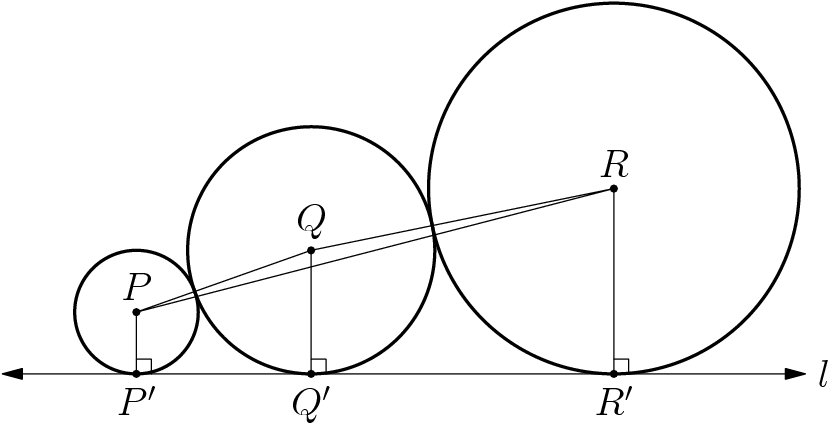
Notice that we can find $[P'PQRR']$ in two different ways: $[P'PQQ']+[Q'QRR']$ and $[PQR]+[P'PRR'].$ Since we want $[PQR],$ we use the latter method, so we have $[P'PQQ']+[Q'QRR']=[PQR]+[P'PRR'].$
$P'Q'=\sqrt{PQ^2-(QQ'-PP')^2}=\sqrt{3^2-1^2}=\sqrt{8}=2\sqrt{2}$. Additionally, $Q'R'=\sqrt{QR^2-(RR'-QQ')^2}=\sqrt{5^2-1^2}=\sqrt{24}=2\sqrt{6}$. Therefore, $[P'PQQ']=\frac{P'P+Q'Q}{2}*2\sqrt{2}=\frac{1+2}{2}*2\sqrt{2}=3\sqrt{2}$. Similarly, $[Q'QRR']=5\sqrt6$. We can calculate $[P'PRR']$ easily because $P'R'=P'Q'+Q'R'=2\sqrt{2}+2\sqrt{6}$. $[P'PRR']=4\sqrt{2}+4\sqrt{6}$. $\newline$
Plugging into first equation, the two sums of areas, $3\sqrt{2}+5\sqrt{6}=4\sqrt{2}+4\sqrt{6}+[PQR],$ so therefore $[PQR]=\boxed{\textbf{(D) }\sqrt{6}-\sqrt{2}.}$
Solution 2
Use the Shoelace Theorem.
Let the center of the first circle of radius 1 be at $(0, 1)$.
Draw the trapezoid $PQQ'P'$ and using the Pythagorean Theorem, we get that $P'Q' = 2\sqrt{2}$ so the center of the second circle of radius 2 is at $(2\sqrt{2}, 2)$.
Draw the trapezoid $QRR'Q'$ and using the Pythagorean Theorem, we get that $Q'R' = 2\sqrt{6}$ so the center of the third circle of radius 3 is at $(2\sqrt{2}+2\sqrt{6}, 3)$.
Now, we may use the Shoelace Theorem!
$(0,1)$
$(2\sqrt{2}, 2)$
$(2\sqrt{2}+2\sqrt{6}, 3)$
$\frac{1}{2}|(2\sqrt{2}+4\sqrt{2}+4\sqrt{6})-(6\sqrt{2}+2\sqrt{2}+2\sqrt{6})|$
$=\boxed{\textbf{(D) }\sqrt{6}-\sqrt{2}.}$
Solution 3
$PQ = 3$ and $QR = 5$ because they are the sum of two radii. $QQ' - PP' = 1$ and $RR' - QQ' = 1$, the difference of the radii. Using pythagorean theorem, we find that $P'Q'$ and $Q'R'$ are $\sqrt{8}$ and $\sqrt{24}$, $P'R' = \sqrt{8} + \sqrt{24}$.
Draw a perpendicular from $P$ to line $RR'$, then we can use the Pythagorean theorem to find $PR$. $RR' - PP' = 2$. We get\[PR^2 = (\sqrt{8} + \sqrt{24})^2 + 4 = 36 + 16\sqrt{3} \Rightarrow PR = \sqrt{36 + 16\sqrt{3}} = 2\sqrt{9 + 4\sqrt{3}}\]
To make our calculations easier, let $\sqrt{9 + 4\sqrt{3}} = a$. The semi-perimeter of our triangle is $\frac{3 + 5 + 2a}{2} = 4 + a$. Symbolize the area of the triangle with $A$. Using Heron's formula, we have\[A^2 = (4 + a)(4 + a - 2a)(4 + a - 3)(4 + a - 5) = (4 + a)(4 - a)(a + 1)(a - 1) = (16 - a^2)(a^2 - 1)\]We can remove the outer root of a.\[A^2 = (16 - 9 - 4\sqrt{3})(9 + 4\sqrt{3} - 1) = (7 - 4\sqrt{3})(8 + 4\sqrt{3}) = 8 - 4\sqrt{3} \rightarrow A = \sqrt{8 - 4\sqrt{3}}\]
We solve the nested root. We want to turn $8 - 4\sqrt{3}$ into the square of something. If we have $(a - b) ^ 2 = 8 - 4\sqrt{3}$, then we get\[\begin{cases} a^2 + b^2 = 8 \\ ab = 2\sqrt{3} \end{cases}\]Solving the system of equations, we get $a = \sqrt{6}$ and $b = \sqrt{2}$. Alternatively, you can square all the possible solutions until you find one that is equal to $8 - 4\sqrt{3}.$ $\newline A = \sqrt{8 - 4\sqrt{3}} = \sqrt{(\sqrt{6} - \sqrt{2})^2} = \boxed{\textbf{(D) }\sqrt{6}-\sqrt{2}.}$ ~ZericH
Solution 4
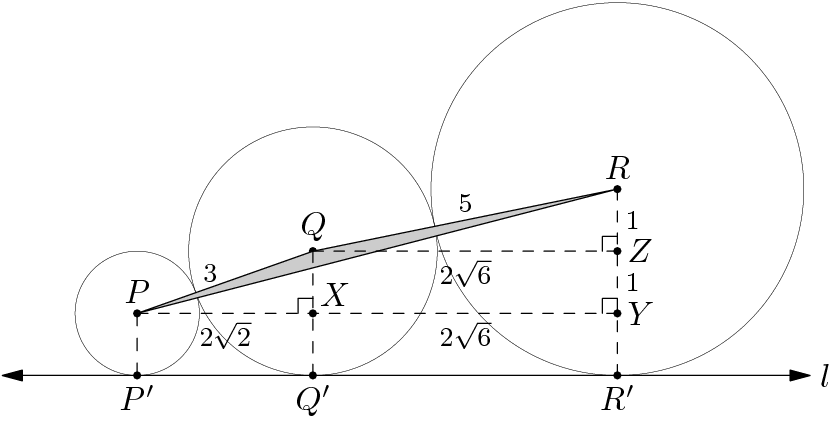
The above diagram can be achieved relatively simply using basic knowledge of the Pythagorean theorem and the fact that the radius from the center to the point of tangency is perpendicular to the tangent line. From there, observe that $[PQRY]$ can be calculated in two ways: $[\triangle PQX] + [QZYX] + [\triangle QRZ]$ and $[\triangle PRY] + [\triangle PQR]$. Solving, we get:\begin{align*} [\triangle PQR] &= [PQRY] - [\triangle PRY] \\ &= [\triangle PQX] + [QZYX] + [\triangle QRZ] - [\triangle PRY] \\ &= \sqrt{2} + 2\sqrt{6} + \sqrt{6}- 2\sqrt{2}-2\sqrt{6} \\ &= \boxed{\textbf{(D)} \sqrt{6}-\sqrt{2}} \end{align*}
- ColtsFan10, diagram partially borrowed from Solution 1
Solution 5 (Heron’s)
We can use the Pythagorean theorem to find that the lengths are $3,5,\sqrt{36+16\sqrt{3}}$. If we apply Heron’s, we know that it must be the sum (or difference) of two or more square roots, by instinct. This means that $\boxed{\textbf{(D)} \sqrt{6}-\sqrt{2}}$ is the answer.
Solution 6 (Educated Guess)
Like Solution 1, we can use the Pythagorean theorem to find $P'Q'$ and $Q'R'$, which are $2\sqrt2$ and $2\sqrt6$ respectively. Since the only answer choice that has $\sqrt2$ and $\sqrt6$ is $D$, we can make an educated guess that $\boxed{\textbf{(D)} \sqrt{6}-\sqrt{2}}$ is the answer.
Solution 7 (Quickest and Easiest Using Trapezoids)
The fastest way to find the area of $[PQR]$ is by breaking it into shapes with easy-to-calculate areas. We can see that the area of the whole shape $[PQRR'P']$ is made up of trapezoids $[PP'QQ']$ and $[Q'QRR']$. So, $[PQR]=[PP'QQ']+[Q'QRR']-[PRR'P']$.
We already know the lengths of $PP'$ and $QQ'$ being $1$ and $2$ respectively (they are the radiuses of the circles). The "height" of the trapezoid is $P'Q'=\sqrt{3^2-1^2}=\sqrt{8}=2\sqrt{2}$ which can be found from the Pythagorean Theorem. So, the area of trapezoid $[PP'QQ']=\frac{1+2}2*{(2\sqrt{2})}=3\sqrt{2}$. Similarly, we can find the area of trapezoid $[Q'QRR']$. $Q'R'=5\sqrt{6}$, so $[Q'QRR']=\frac{2+3}2*{(2\sqrt{6})}=5\sqrt{6}$.
Now we can put the pieces together. $[PQR]=[PP'QQ']+[Q'QRR']-[PRR'P']=3\sqrt{2}+5\sqrt{6}-[PRR'P']=$. The area of $PRR'P'$ is the long rectangle $[PR"R'P]'+ [PRR"]=4\sqrt{2}+4\sqrt{6}$. $R"$ is the point on $RR'$ in which $PR"$ is perpendicular to $RR'$.
So, $[PQR]=3\sqrt{2}+5\sqrt{6}-(4\sqrt{2}+4\sqrt{6})=\boxed{\textbf{(D) }\sqrt{6}-\sqrt{2}.}$
~hwan